

From Sydney to Hong Kong, wealth migration is reshaping the global super-luxury property market as activity picks up after two subdued years – though the dominance of relative newcomer Dubai is now being tested by the war in the Middle East.
In Sydney, Peter Li, general manager at Plus Agency, said commission revenues on super-luxury homes had risen about 20 per cent from a year earlier. The firm, which handles more than US$300 million in annual sales, has hired six new staff members since January and expanded its bonus pool as high-end buyers return.
“The activity level this year feels very different as clients are moving with conviction,” Li said, adding that he made the right call in increasing staffing levels.
Since the start of the year, the agency has hosted three large events and increased VIP viewings, particularly around Chinese New Year. One team even organised a concert featuring an overseas performer, drawing about 2,000 attendees and generating new sales leads.
“The extra expense is worth it,” Li said.
The mood is similarly upbeat in Hong Kong.
“We have been so busy that we still have not had the time to celebrate,” she said. “It’s a time to acknowledge the perseverance and the sheer grit it took. In a market that’s been as challenging as this one, professional satisfaction feels more profound.”
The reactions of Li and Chu reflect a broader shift at the very top end of the market. After nearly two years of subdued activity, global momentum is growing.
Across 12 key markets, property consultancy Knight Frank recorded 555 super-luxury residential transactions above US$10 million in the fourth quarter of 2025, an increase of 17 per cent from the previous quarter. Total sales value rose 20 per cent to US$10.3 billion, while the average deal size edged up to US$18.6 million from US$18.1 million in the same period.
Hong Kong and Sydney were among the fastest-growing markets in the fourth quarter, according to Knight Frank.
Hong Kong recorded 81 of these sales, also known as super-prime transactions, up 45 per cent from the previous quarter, with total value rising 51 per cent to US$1.6 billion. Sydney saw 52 deals, a 58 per cent quarter-on-quarter increase – one of the strongest gains among the 12 markets tracked.
The recent revival has been driven primarily by affluent buyers from mainland China, where property markets remain under strain. As investors seek to diversify, Hong Kong offers a strong legal system, currency stability and deep liquidity. A limited supply of prime real estate has also reinforced the city’s appeal.
“Our clients see the inherent scarcity of prime luxury properties in Hong Kong as a compelling long-term value proposition,” Chu said. “They are looking for assets that offer both wealth preservation and lifestyle enhancement.”
Sydney’s rebound reflects different dynamics. Australia’s political stability, transparent regulatory environment and lifestyle appeal continue to anchor demand at the ultra-prime level. While the country’s broader housing market remains sensitive to rates, the top end has proved resilient, supported by domestic entrepreneurs and returning expatriates reallocating capital.
The recoveries in Hong Kong and Sydney point to a wider pattern: global wealth is mobile again, but selective about where it lands.
According to Swiss bank UBS’s billionaire report in December, 36 per cent of those surveyed relocated at least once in 2025, driven by geopolitical concerns, quality of life considerations and tax efficiency.
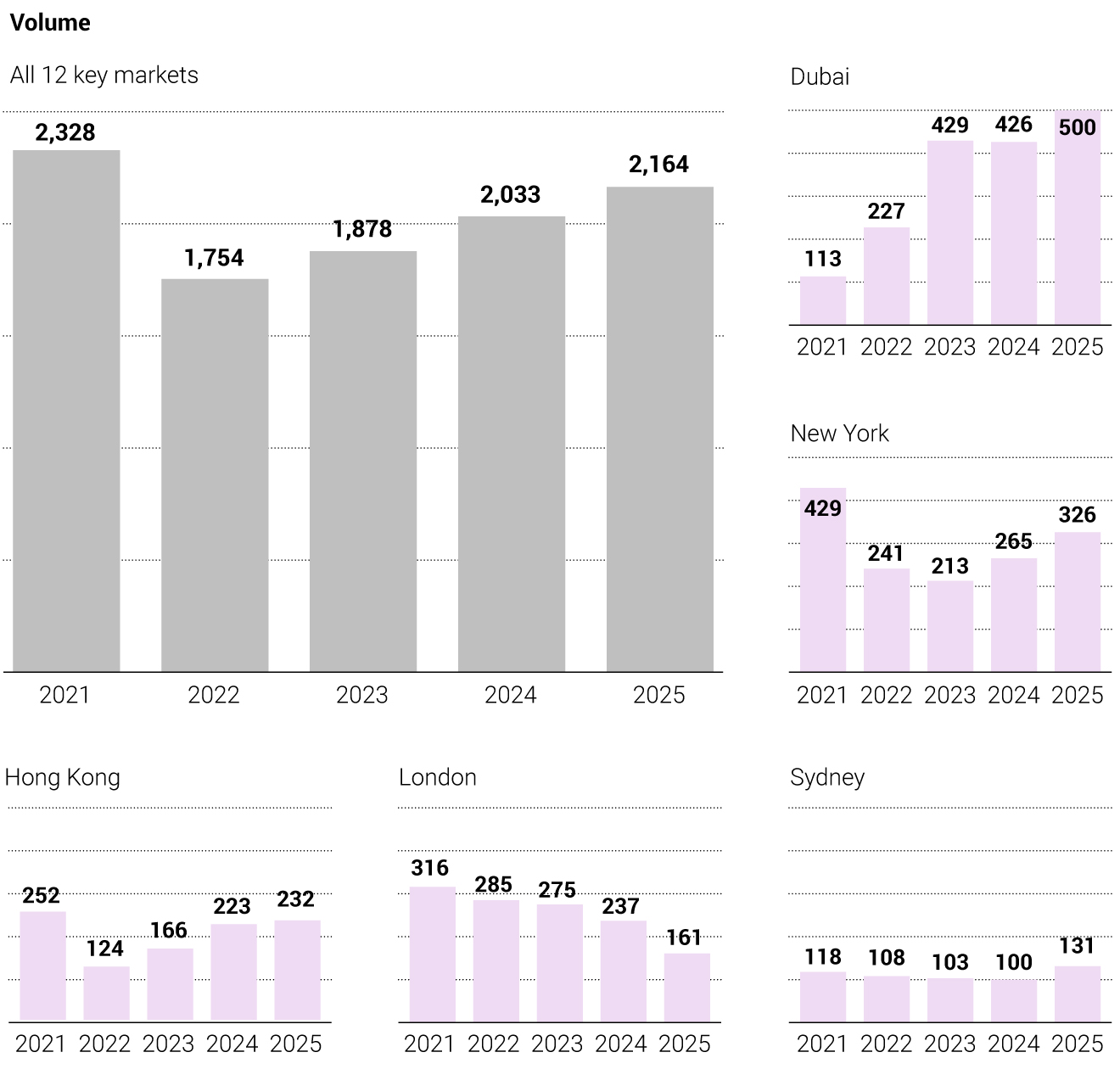
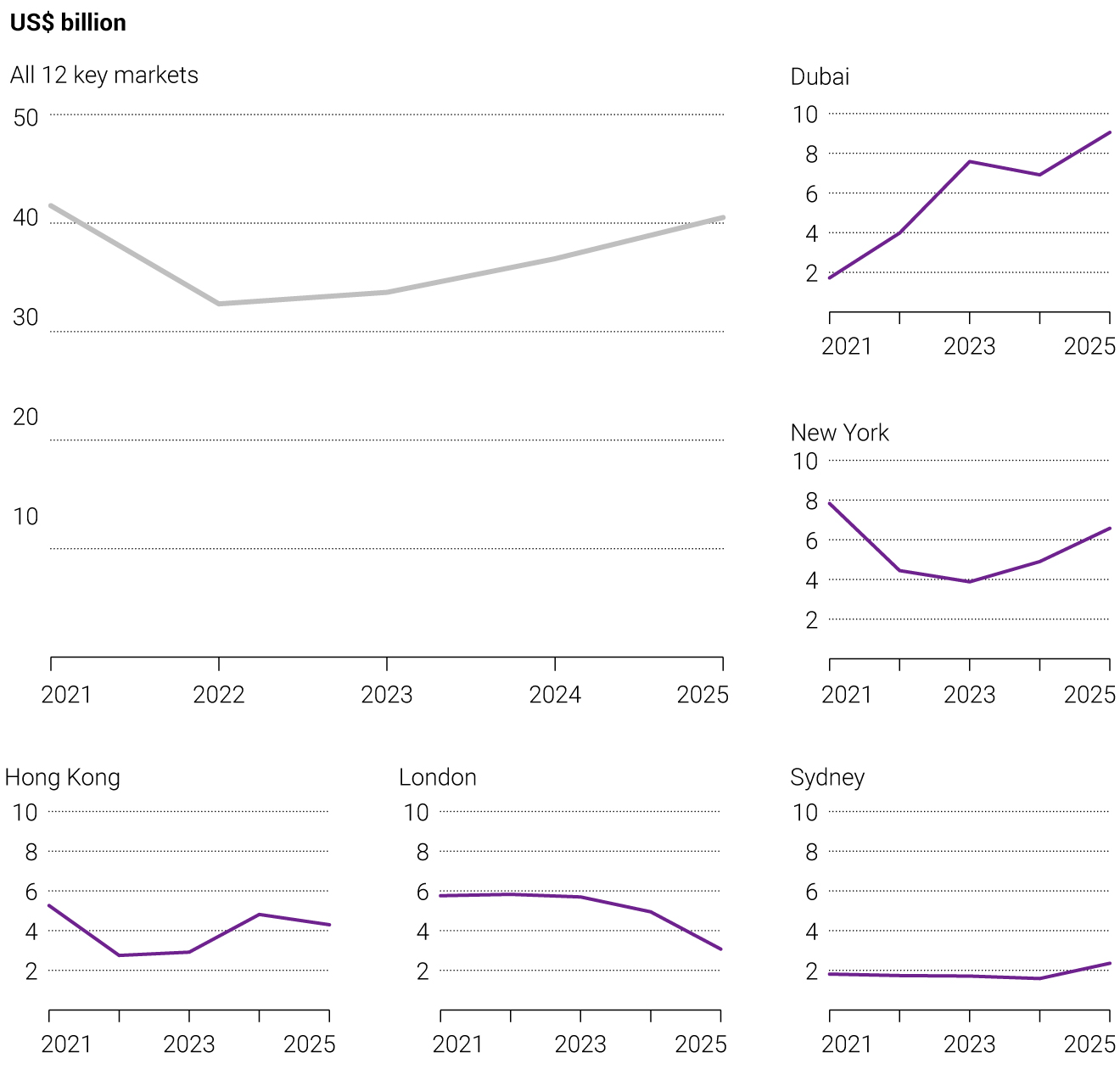
Based on these criteria, Dubai leads the charts, at least for now.
“Dubai’s record year capped a powerful multi-year run of wealth inflows and super-prime new-build delivery,” the report said.
Behind this migration lies an expanding pool of global wealth.
The UBS report showed that the number of billionaires worldwide continued to rise along with their aggregate net worth. Technology, finance and industrial sectors were the dominant sources of wealth creation, but digital assets emerged as a growing category.
Property agents said the increase in the number of cryptocurrency millionaires had translated into more buyers for luxury homes using digital wealth.
“We regularly get inquiries from people asking if they can use crypto to buy property,” said Li at Plus Agency, which recently set up the ability to process cryptocurrency payments, including stablecoins, after losing a deal it could not settle in digital assets. “From a vendor’s perspective, they are cash buyers.”
Li said many cryptocurrency-linked buyers were under 40 and held assets offshore. Budgets typically ranged from US$4 million to US$20 million, with demand focused on central locations and views rather than long-term family considerations.
“They’re looking for lifestyle,” he said. “Mostly, crypto buyers are looking for a party house, not a place to raise a family.”
Dubai has been a top beneficiary of the digital wealth wave. Its regulatory openness towards virtual-asset businesses and low-tax environment have drawn cryptocurrency entrepreneurs and blockchain executives seeking both residence and investment diversification.
Other cities are also adapting.
London has seen similar inquiries, according to Asim Arshad, a partner and cryptocurrency and digital assets lead at law firm Irwin Mitchell.
“There is definitely a lot of interest from Asia, including Chinese origin wealth,” Arshad said.
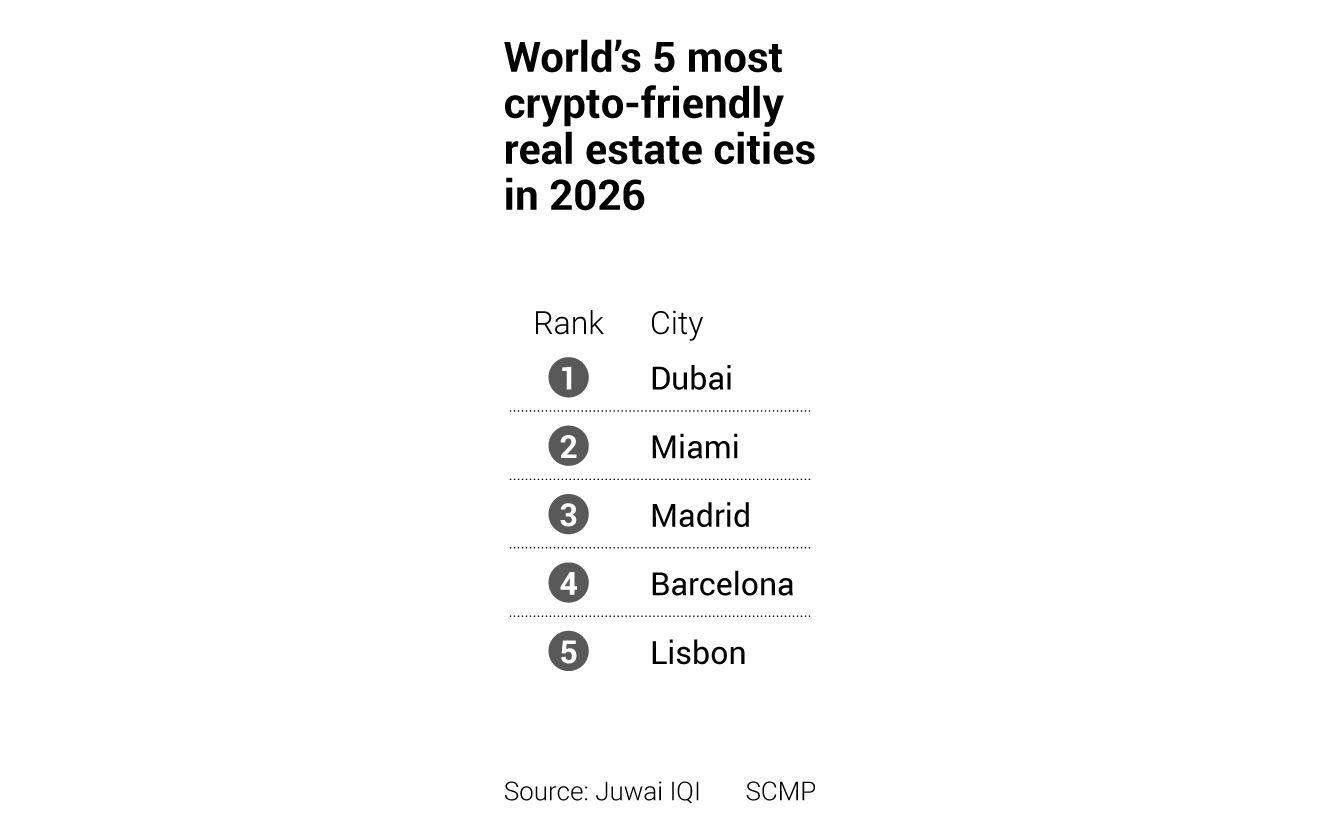
In Miami and Dubai, digital assets have already played a visible role in transactions, according to Kashif Ansari, founder and group CEO of real estate broker Juwai IQI. He estimated that at least 25 per cent of residential property buyers in Dubai funded some or all of their purchases with cryptocurrency assets.
Such reliance on cryptocurrency buyers has made these markets more vulnerable to overheating.
The latest Global Real Estate Bubble Index from UBS showed Miami topping the global bubble-risk chart, while Dubai faced “elevated risk” after prices surged faster than local incomes. By contrast, Hong Kong and London, following prolonged corrections, remained in lower-risk categories.
The value of digital assets started falling in late 2025, with bitcoin currently trading at around US$72,700 compared with a record high of around US$126,000, exposing leverage and liquidity fragility across the ecosystem.
As a result, the relationship between digital assets and luxury homes can be fluid.
“When crypto prices rise, investors may take the chance to cash out profits to buy property,” said Livio Weng, CEO of Sinohope, a Hong Kong-based Web3 company. “But as crypto believers, when prices fall, they could sell their luxury homes to buy coins.”
Amid rising geopolitical risks, capital calculations are shifting again.
As the situation continues to evolve, it remains unclear how the market will react.
“The war is a serious event, but history has been on Dubai’s side,” Juwai IQI’s Ansari said. “Every time there’s been a crisis – the Iraq war, the Arab spring, the pandemic – Dubai has emerged stronger.”
Ansari added that day-to-day life in Dubai was largely unaffected.
Due to the heightened tensions in the Middle East, some property agents said clients were reassessing priorities. While transaction volumes in Dubai remained strong, contingency planning had re-entered conversations, they added.
Benny Sham, a Hong Kong-based research analyst at Midland Realty, said escalating geopolitical risks could prompt some Middle Eastern and Asian investors to look towards Hong Kong.
He said that the number of wealthy Chinese residents in the UAE had grown in recent years, with about 370,000 Chinese nationals living in the Gulf country in 2025.
Hong Kong is seeking to capture some of that mobile capital. Its revamped cash-for-residency programme, the New Capital Investment Entrant Scheme, had attracted 3,166 applications by the end of February, with 1,762 approvals generating roughly US$2 billion in investment.
The government eased property investment requirements under the scheme last year in a bid to boost demand for luxury homes.
“Against the backdrop of rising geopolitical risks in the Middle East, more high-net-worth individuals and capital are likely to be diverted from the region to Hong Kong,” Sham said.
While Dubai’s residency threshold requirements were lower, Hong Kong offered stronger legal protection and perceived political stability, he added.
For Chu at Hugill & Ip, the recovery goes beyond a simple rebound.
She said transaction structures were becoming more sophisticated, with greater use of family offices and corporate holding vehicles as buyers adopt a more institutional approach to ownership.
“We’re not just witnessing a cyclical recovery; we’re seeing a strategic repositioning of capital towards top-tier assets,” she said.
This article is for information purposes only. Its contents do not constitute legal advice and readers should not regard this article as a substitute for detailed advice in individual instances.