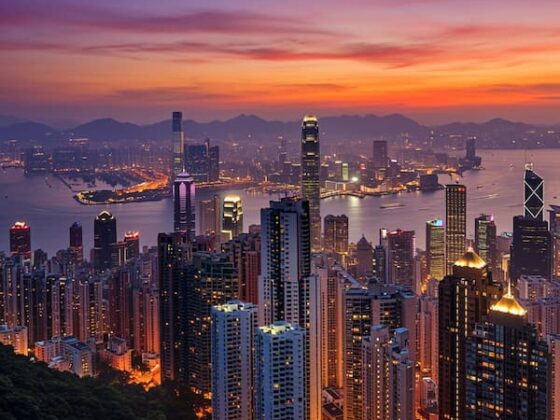


The ongoing recovery in Hong Kong’s residential and Grade A office space continues to drive an uneven property rebound across the Asian financial hub. That turnaround bodes well for the Greater Bay Area (GBA). Despite accounting for just two percent of its physical land, Hong Kong’s real estate value is estimated to command between a third and half of the GBA’s total, underscoring the city’s swing factor in shaping regional sentiment.
But while momentum behind Hong Kong is improving, neighbouring Macao remains lacklustre. Against Hong Kong’s uptick, Macao’s residential home sales experienced a second-quarter slowdown with mass-market and high-end property prices falling 1.2 percent and 0.4 percent respectively, according to JLL’s Macau Property Outlook.
That sluggishness is unfolding amid relatively upbeat expectations. Economists at the University of Macau are forecasting GDP growth to reach 6 percent this year while analysts at JPMorgan are pencilling gaming revenues to top 258 billion patacas (US$32 billion), a 5 percent increase from 2025.
Although encouraging, those gains show themselves to be highly concentrated, said Mark Wong, senior manager, valuation and advisory services at JLL. Speaking to The Bay, the property expert noted that the gaming and tourism sectors drive most of that growth and do not directly stimulate residential or local office demand.
However, rising bond yields do present a challenge, he added, as an uncertain global interest rate outlook and prospects of rising funding costs temper investor enthusiasm.
The JLL report mentions that even as first-quarter retail sales rose 13.7 percent – helped in part by tourism spending – supermarket sales, a bellwether for local conditions, declined 5.3 percent, highlighting the discrepancy between visitor-driven demand and local domestic conditions.
Macao property: changes at the margins
Officials are bridging the disconnect through Macao’s 1+4 Development Plan, which looks to foster a world centre for tourism and leisure alongside four nascent industries that include life sciences, finance, and meetings and convention services. Released in August, the SAR’s Third Five-Year Plan reinforces this urgency, laying out a vision for non-gambling industries to account for around 60 percent of gross domestic product.
Preliminary signs of the transition have been encouraging. The focus on the premium mass segment underscores a pivot to higher margin players while MICE attendees have risen 39 percent this year despite Macao hosting the same number of events.
But relying on volume growth presents its own setbacks. Bottlenecks are visible due to venue capacity limits and scheduling availability just as higher marketing costs are eating away at the efficiency gains. Even as mass gambling now accounts for 130 percent of its pre-pandemic revenues, profits have only recovered around 55 percent of those levels, according to Morgan Stanley.
Conversely, Hong Kong is seen adopting an upmarket growth approach by deepening its wealth management ambitions and targeting luxury asset flows. In November, the city will host its inaugural Festival of Connoisseurs at a time when capital market deals attract high-net-worth individuals and drive demand for Grade A office space.
In Macao, supply still exceeds demand. But even as a pending influx of non-performing assets continues to weigh on asset values, what may be more revealing is how the city’s next stage of growth is developing, said Jun Yan, an independent analyst, in conversation with The Bay.
Easing rental fees have coincided with a surprising uptick in new company registrations, suggesting that a swath of new businesses may be taking advantage of lower costs while planning out their regional expansion.
“The GBA works when companies can use different cities for different jobs,” Yan explained, arguing that new business registrations in Macao and falling rents are not necessarily contradictory.
The point was echoed by JLL’s Wong, who noted that most new entities were financial and insurance companies that typically maintained regional hubs in Hong Kong or other first-tier cities while utilising Macao as a specialised office linked to their GBA strategy.
Sidelined supply
Both SARs remain vulnerable to supply-side pressure. Just as Hengqin’s land space prompts a rethink on Macao-based strategies, Hong Kong’s Northern Metropolis development realigns future economic activity closer to Shenzhen and away from Central or the offices adjacent to Victoria Harbour.
The GBA should not be seen as a single property market, and instead be viewed as a mechanism for redistributing demand, commented Polly Chu, partner and head of real estate at Hugill & Ip, in remarks sent to the Bay.
While the Northern Metropolis project remains an infrastructure and execution proposition rather than an immediate demand driver, the more meaningful test comes in 2027 when new Grade A space becomes available.
“Next year the price data will show whether new demand can absorb the incoming supply, rather than reflecting tenants simply moving from one district to another,” she says.
Despite uneven outlooks in both SARs, several foreign brands are utilising cheaper retail space to secure lower entry costs in their respective markets. Earlier this month, American ice cream chain Dairy Queen announced plans to open four outlets in Hong Kong this November and reach 60 stores by 2034, returning to the city after a brief stint in the late 1970s.
A similar trend is playing out in Macao. Riding the wave of “China Chic” fads, domestic brands are also moving in tourist-heavy locations like Senado Square to take up space once allocated to luxury tenants. Each SAR has recorded comparable growth in tourism traffic from mainland China, where an appreciating renminbi supports cross-border purchasing power in Hong Kong dollar and Macao pataca terms.
But incentives to attract these tenants remain a key factor to watch going forward, Chu says.
“The central issue is vacancy. Until it falls decisively, landlords are likely to continue using rent-free periods and other incentives to secure occupiers,” she shares, describing a strategy that places downward pressure on rental leases.
The JLL report added that it expects Macao’s broader market to remain flat as the sector lacks a visible growth catalyst for the moment.
The article was originally published on The Bay